We Want to Move the North: An Introduction.
Written by Molly Hogan-Thomas. Edited by Chelsea Pelletier & Gloria FoxIntroduction the Physical Activity Alliance of Northern British Columbia
We are the Physical Activity Alliance of Northern British Columbia (PAANBC). PAANBC is a group of organizations throughout British Columbia (B.C.) working together to improve opportunities for physical activity across rural and Northern B.C.
PAANBC is led by the Physical Activity Research Lab, which operates out of the University of Northern British Columbia in Prince George, B.C. This network aims to support organizations and communities across the North in getting more people moving. To learn more about PAANBC, visit our About Us page.
Now that we have explained who we are, we should explain why focusing on supporting physical activity in rural and Northern communities is important.
Physical Activity in Rural and Northern Areas
In 2021, nearly 6 million people lived in rural communities in Canada. These communities often have unique cultures and ways of life that differ from larger, mostly southern urban city centres.¹ Research suggests that people living in rural communities often face greater physical health challenges.¹ There are many reasons people living in urban and rural communities experience different health outcomes, including access to health care, access to healthy food, and different environmental exposures.² Another reason for this is that rural and Northern communities participate in lower levels of physical activity.³ Because we know that physical activity has many health benefits, understanding why people in rural and Northern communities are less physically active is important to be able to support more movement in these communities.
If you have read this far, you may be wondering what we mean by rural and Northern communities, and even what we mean by physical activity. Keep reading, and we will explain exactly how we define these concepts!
Definitions
Defining Physical Activity
Physical activity is any movement that uses energy and makes your heart beat faster. Physical activity includes exercise, sports, recreation, active forms of transportation (such as walking, wheeling, or cycling), work that includes physical labour, and household chores.⁴,⁵
Defining Rural and Northern Communities
Defining Northern communities can be challenging. In Canada, the North is often thought of as the three territories (Northwest Territories, Nunavut, and the Yukon).⁶ However, the provinces also identify their own Northern regions, often called the Provincial North.⁶,⁷ For an idea of the land this covers, see the map from Statistics Canada below.⁵ The Provincial North tends to include less populated areas with more remote and rural communities that are structurally different them urban areas with a more spread out built environment.
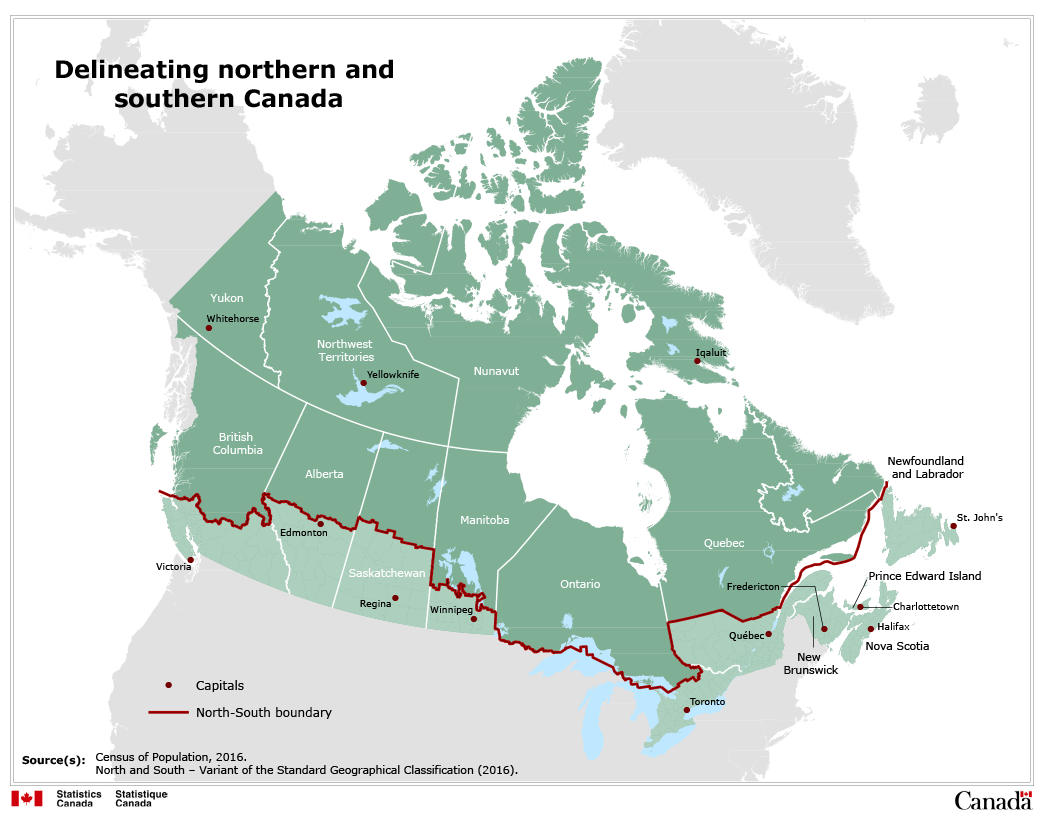
A map of the Canadian North, including the Provincial north barriers, where the red line delineates the North-South boundary, and the white line delineates province and territories. (Credit: Statistics Canada)
There is no single way to define a rural community. Different organizations may use different definitions. The B.C. government suggests that rural communities be identified by their population size and how far they are from larger cities.⁸ Communities with smaller populations and greater distances from urban centres are typically considered rural.⁸ For more details, see the image below.
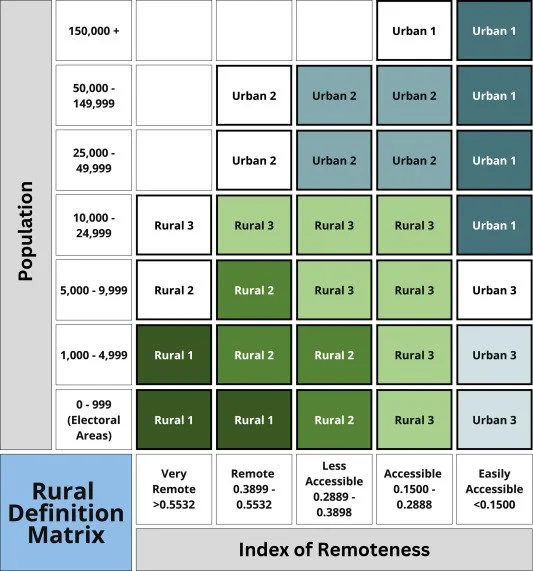
The rural matrix. Credit: Hammond, Breen, & Gibson, 2026
But at this point, you are probably wondering why we are talking about all of this?
PAANBC Goals
As part of our partnership, PAANBC will publish a series of blog posts sharing evidence-backed information, tips, and strategies to promote physical activity in rural and Northern communities.
We will be kicking off our series with a blog about the factors that affect participation in physical activity in the North. This post will explore some of the unique challenges that can make it harder for people in rural and Northern communities to be physically active. Over the coming year, we will partner with organizations throughout the North to explore solutions to these barriers and other topics related to physical activity promotion.
If you have a topic you would like to suggest, feedback you would like to provide, would like to submit your own blog post (that is relating to physical activity in rural and Northern communities), or are an organization that would like to partner with us on a blog post, please submit it to our Community Engagement section.
Summary
PAANBC is a network of organizations throughout the North focused on increasing physical activity within rural and Northern communities. Rural and Northern communities have greater health disparities and lower levels of physical activity. PAANBC is releasing a set of blog posts to share information, resources, and solutions that support healthier and more active rural and Northern communities.
References
1. Pelletier C, Ward K, Aird C, et al. Barriers and facilitators to physical activity in rural communities: Using the Behaviour Change Wheel to identify intervention functions. BMC Public Health. 2025;25(1):3315. doi:10.1186/s12889-025-24672-2
2. DesMeules M, Pong RW, Read Guernsey J, Wang F, Luo W, Dressler MP. Rural health status and determinants in Canada. Health in rural Canada. 2012;1:23-43.
3. Pelletier CA, White N, Duchesne A, Sluggett L. Barriers to physical activity for adults in rural and urban Canada: A cross-sectional comparison. SSM Popul Health. 2021; 16:100964. doi:10.1016/j.ssmph.2021.100964
4. Alamilla RA, Kaushal N, Bigatti SM, Keith NR. Comparing barriers and facilitators to physical activity among underrepresented minorities: Preliminary outcomes from a mixed-methods study. Int. J. Environ. Res. Public Health. 2025;22(2):234. doi:10.3390/ijerph22020234
5. World Health Organization. Physical activity. Published June 26, 2024. Accessed June 17, 2026. https://www.who.int/news-room/fact-sheets/detail/physical-activity
6. Statistics Canada. Delineating Northern and Southern Canada. Government Of Canada. Published July 4, 2019. Accessed June 18, 2026. https://www150.statcan.gc.ca/n1/daily-quotidien/190704/mc-a001-eng.htm
7. Statistics Canada. North and South - Variant of SGC 2021 - Additional information. Government of Canada. Published February 9, 2022. Accessed June 18, 2026. https://www23.statcan.gc.ca/imdb/pUtil.pl?Function=getNote&Id=1372103&NT=04
8. Hammond D, Breen SP, Gibson R. A rural matrix: A pragmatic alternative approach to defining rural for policy and practice. J Rural Stud. 2026; 123: 104066. doi:10.1016/j.jrurstud.2026.104066