Written by Molly Hogan-Thomas, B.Sc. (Hons.). Edited by Chelsea Pelletier, Ph.D & Gloria Fox, M.A.Introduction
In our last blog, we introduced who we are, our mission and goals, and the objectives of this blog post series (to see that post click here). In this post, we explore the factors that make it harder for people living in rural and northern communities to be physically active.
Barriers are things that make it harder to be physically active. Barriers to physical activity have been noted across many communities and countries, including Canada.¹ Even though some rural and northern communities have increased access to parks, trails, and natural spaces, residents typically report lower levels of physical activity.²,³,⁴ This is likely because of the unique barriers that come with living in rural and northern communities, such as a lack of access to indoor spaces, more severe winter weather, and less access to services in the community that support activity. Understanding these challenges can help communities and organizations when designing programs to encourage physical activity in rural, remote, and northern Canada.⁴
Common Barriers to Physical Activity in Canada
Many barriers that are experienced in rural and northern communities are also experienced by people in urban cities. Examples include time, support to be active, individual confidence and motivation, and financial ability to afford the activities. We will not cover common barriers in this blog post, as they have been widely studied and reported on. However, if you want to know more, ParticipACTION has a great blog post that discusses these barriers in detail.
Unique Barriers to Physical Activity
The Built Environment
Many rural communities are not built for biking or walking. Homes, workplaces, and services are often located far apart, with few or no sidewalks, bike lanes, and buses.⁵ People report avoiding biking and walking for transportation because it feels unsafe or will take too much time.² Limited infrastructure can make other barriers, such as weather conditions, or a lack of time or money, more difficult to overcome, because of the increased travel needs.⁶
Social Support
Social support plays an important role in physical activity engagement everywhere.¹ However, it is especially important in rural and northern communities.¹ Strong community connections are one of the biggest strengths of many rural and northern communities and can encourage people to be more physically active. Likewise, a lack of social support can be a greater barrier to physical activity in rural and northern communities.¹ It is unclear exactly why this is; however, a study looking at healthy ageing and the role of social support found that there were fewer community facilities and support in rural communities.⁷ So, people often depended on friends, family, and neighbours for support.⁷ In rural and northern communities, limited infrastructure often means people rely on outdoor spaces for physical activity. Because outdoor activities such as hiking can involve environmental and safety risks, people are often encouraged not to participate alone. As a result, friends, family, and community members can play an important role in supporting safe participation in outdoor exercise. This suggests that strengthening social connections and community support may help reduce some of the barriers created by a lack of facilities. Research supports this idea, with people in rural and northern communities identifying hiking and running groups as factors that help them stay active.²
Wildlife Safety
Outdoor activities such as hiking are often affordable and popular ways to stay active in rural, remote, and northern communities. We have some of the best outdoor playgrounds around! However, concerns about wildlife safety can discourage participation.² Educating people on wildlife safety could help people feel more confident and encourage being active outdoors.
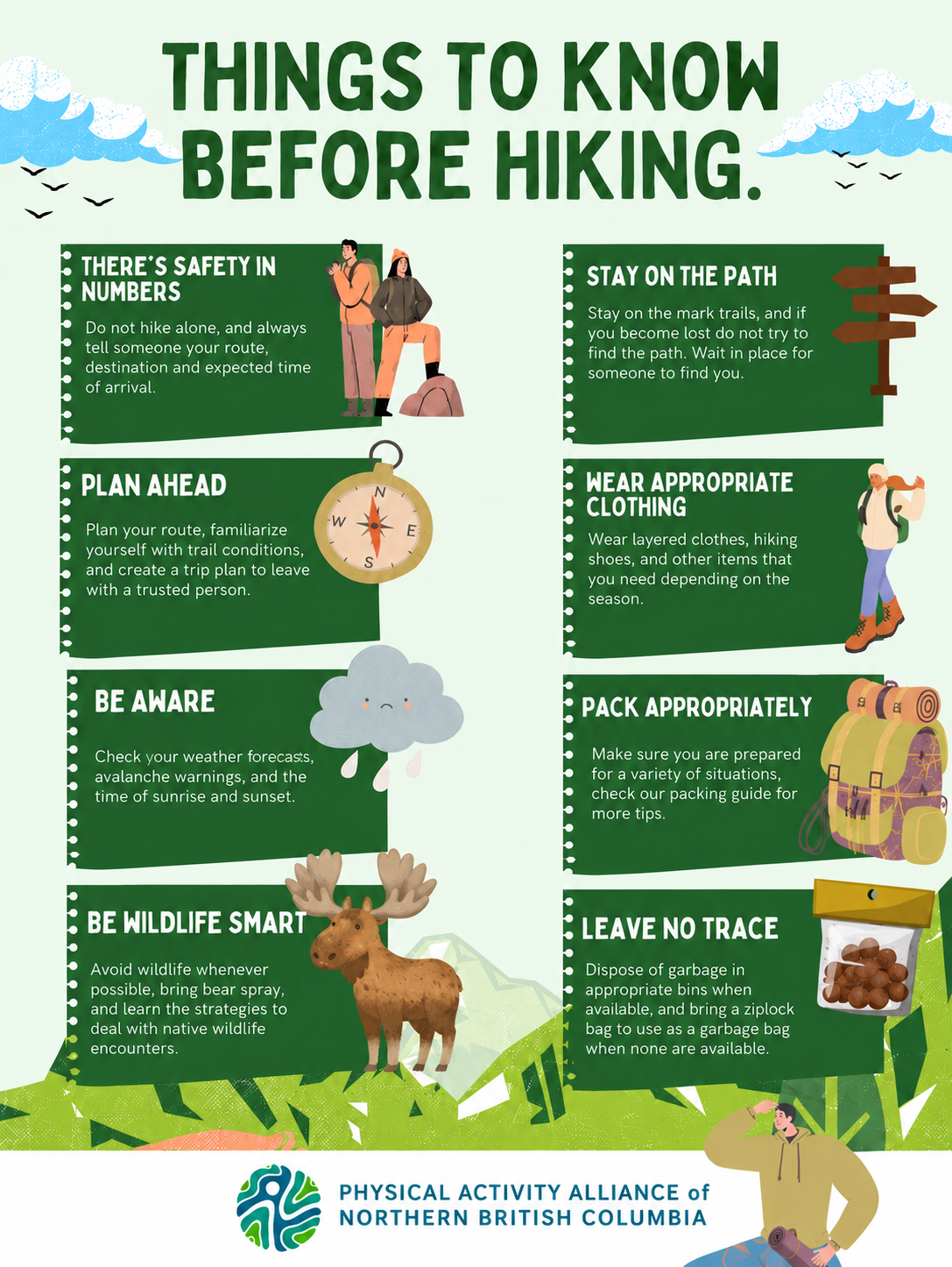
Hiking safety infographic.
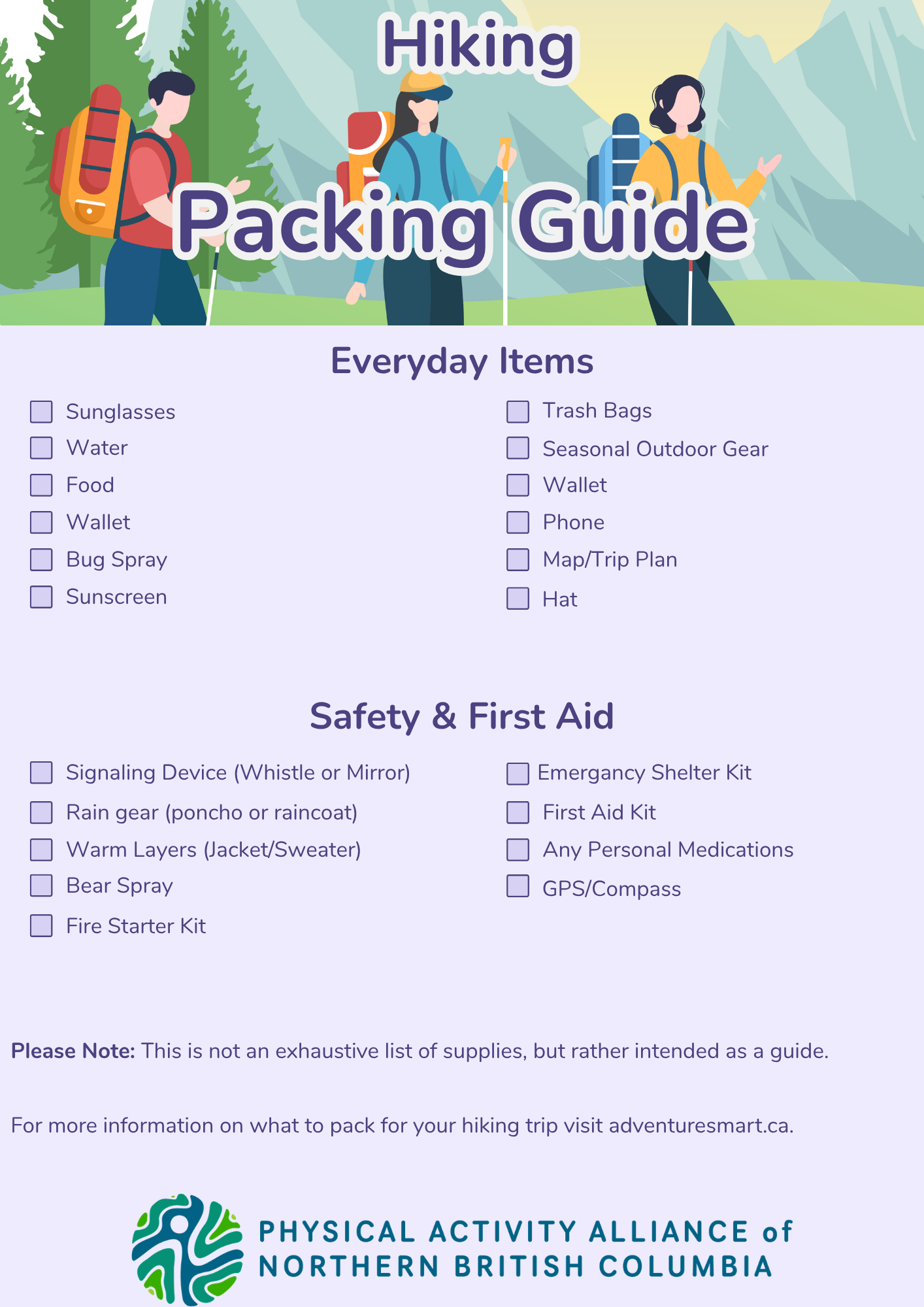
A hiking checklist.
Knowledge of the Area
Another key barrier people report is navigating the wilderness, with many reporting a fear or experience of getting lost.² Fortunately, technology can help reduce this barrier with several free hiking apps that can help people plan routes and navigate trails safely. Remember that much of our northern wilderness doesn’t have cellular service, so it’s always a good idea to download maps ahead of time for offline use. Community organizations and municipalities often produce local recreation and trail guides that can be helpful when navigating a new place. If you are looking for municipal information visit our Active Northern Living page where we link to major municipal hubs in northern B.C.
Weather
Weather strongly influences physical activity levels. Research suggests that people are less active during wet, windy and colder conditions.⁶ People in rural communities may be particularly affected because there are often fewer indoor recreation options.¹ Additionally, seasonal weather shifts are often more extreme in northern communities. For example, snow cover can be seen for as long as 224 days out of the year,⁸ with up to 18.5 hours of darkness.⁹* Snow and ice can make walking, cycling, and driving difficult.⁶
Climate Change
Climate change is making it harder for some people to stay active, particularly in rural and Northern communities. This is because many rural and northern communities rely heavily on the natural environment as sources of income, food, and water.¹⁰ Because people in rural and northern communities have a high reliance on the outdoors for physical activity,² natural disasters, such as wildfires, poor air quality, extreme temperatures, and severe weather, can all make outdoor physical activity more difficult.¹¹
Conclusion
Many barriers to physical activity are common across Canada, but people in rural and northern communities often face extra challenges. These can include limited facilities and infrastructure, harsh weather, concerns about wildlife safety, a lack of information, and a greater need for social support. At the same time, these communities have many strengths, including access to nature and strong community connections that can support active lifestyles. Understanding both the challenges and strengths can help communities, organizations, and policymakers create programs, spaces, and resources that make it easier for people to be physically active in rural and northern Canada.
References
1. Pelletier CA, White N, Duchesne A, Sluggett L. Barriers to physical activity for adults in rural and urban Canada: A cross-sectional comparison. SSM Popul Health. 2021; 16:100964. doi:10.1016/j.ssmph.2021.100964
2. Pelletier C, Ward K, Aird C, et al. Barriers and facilitators to physical activity in rural communities: Using the Behaviour Change Wheel to identify intervention functions. BMC Public Health. 2025;25(1). doi:10.1186/s12889-025-24672-2
3. Weigand M, Wurm M, Droin A, et al. Are public green spaces distributed fairly? A nationwide analysis based on remote sensing, OpenStreetMap and census data. Geocarto Int. 2023;38(1). doi:10.1080/10106049.2023.2286305
4. Nigg C, Fiedler J, Burchartz A, et al. Associations between green space availability and youth’s physical activity in urban and rural areas across Germany. Landscape and urban planning. 2024;247:105068-105068. https://doi.org/10.1016/j.landurbplan.2024.105068
5. Hansen AY, Umstattd Meyer MR, Lenardson JD, Hartley D. Built environments and active living in rural and remote areas: A review of the literature. Curr. Obes. Rep. 2015;4(4):484-493. doi:10.1007/s13679-015-0180-9
6. Kallio J, Turpeinen S, Hakonen H, Tammelin T. Active commuting to school in Finland, the potential for physical activity increase in different seasons. Int. J. Circumpolar Health. 2016;75(1):33319. doi:10.3402/ijch.v75.33319
7. Iverson T, Schulze M, Gill K, Switkowski Y, dos Santos IK, Ashe MC. Older adults and social support in rural Canada: A rapid mixed methods systematic review to inform social prescribing. Arch. Gerontol. Geriatr. 2025;139:106022. doi:10.1016/j.archger.2025.106022
8. Bevington AR, Gleason HE, Foord VN. Snow cover timing from satellite imagery: Opportunities for near-real-time mapping and seasonal forecasting. Victoria, B.C.: Canada. B.C. Tech; 2020. Report Number: 129.
9. Sunrise/sunset calculator. Sunrise/sunset calculator. National Research Council of Canada. https://nrc.canada.ca/en/research-development/products-services/software-applications/sun-calculator/ Published August 7, 2012. Accessed June 17, 2026.
10. Kipp A, Cunsolo A, Vodden K, King N, Manners S, Harper SL. At-a-glance - Climate change impacts on health and wellbeing in rural and remote regions across Canada: a synthesis of the literature. Health Promot Chronic Dis Prev Can. 2019;39(4):122-126. doi:10.24095/hpcdp.39.4.02
11. Bernard P, Chevance G, Kingsbury C, et al. Climate Change, Physical Activity and Sport: A Systematic Review. Sports Med. 2021;51(5):1041-1059. doi:10.1007/s40279-021-01439-4
* Time of total daylight calculated for Fort Nelson on Dec 21st, 2025 from the Government of Canadas website.